Fundamentals

Audio Version of the Post:

[audio:MCA.mp3]

I spent the bulk of last night taking a close look at the court case that was just released regarding the detainees at Guantanamo Bay. Below, I’ll do my best to share with you an in-depth summary of the issues which were before the court, along with the ruling and dissent.

Before I begin, I would like to define a term which is central to this case, The Writ of Habeas Corpus. The Writ (as it will be hereafter referred to, ) concerns the right of a prisoner to challenge his incarceration in the courts. This has been a central component of Anglo-American law, enacted mainly to prevent arbitrary detention.

*****

The question before the court, according Justice Randolph who delivered the majority opinion, was whether the federal courts had jurisdiction over petitions for the Writ by alien detainees being held as enemy combatants at Guantanamo. When the court first heard this case back in 2004, it ruled that the federal courts do not have jurisdiction over such matters. This conclusion was based on the fact that the base at Guantanamo Bay is not located on sovereign territory of the United States, rather land leased from Cuba. Therefore, US courts had no jurisdiction over this land.

However, the Supreme Court (USSC) overruled this conclusion, citing a clear subject-matter relationship between US operatives at Guantanamo and the detainees.

Following this, Congress stepped in to draft legislation to clarify the matter. What they came up with was something called the Detainee Treatment Act (DTA.) This act had two specific clauses regarding the Guantanamo detainees:

No court/justice/judge may exercise jurisdiction over:

– applications for the Writ filed by or on behalf of an alien detained by the Department of Defense (DOD) at Guantanamo Bay.

– any action against the United States relating to any aspect of the detention by the DOD of an alien at Guantanamo Bay.

Although Congress believed that this legislation would resolve any further issues confronting the courts, there was a snag as the next case regarding a detainee reached the USSC shortly after the enactment of the DTA. The USSC ruled that it was unclear whether the DTA applied to the case, as it had begun before the passage of the DTA. The issue again was returned to Congress which passed a new law.

The Military Commissions Act (MCA) clarified ambiguities in the DTA and expanded its scope greatly:

No court/justice/judge may exercise jurisdiction over:

– applications for the Writ filed by or on behalf of an alien detained by the United States determined by the US to have been properly detained as an Enemy Combatant or is awaiting such determination.

– any aspect of the detention, transfer, treatment, trial or conditions of confinement of aliens detained by the US determined by the US to have been properly detained as an Enemy Combatant or is awaiting such determination

Furthermore the MCA stated that this new law applied to all cases, including those currently pending.

Thus, based on the language of the MCA, Justice Randolph concludes that the MCA applies, and that the federal courts do not have jurisdiction over the Writs filed by the detainees at Guantanamo.

Having concluded thus, the next step in the analysis regards the constitutionality of the MCA. In the Constitution there is a provision under which the Writ may be suspended, called the Suspension Clause. It states, “the privilege of the Writ of Habeas Corpus shall not be suspended unless when in cases of Rebellion or Invasion public safety may require it.” As this is found in the US Constitution, the court asks whether this applies to aliens (foreigners) located outside of US territory.

Although the defendants cite three very old (mid 18th, early 19th century) British cases regarding aliens being tried in the courts, Justice Randolph finds that none of the cases involve an alien outside of the sovereign territory of the Crown. That is, in each of the cases, the detainees had either been living in or were imprisoned within British territory. As precedent, Justice Randolph points to a Supreme Court case from 1950 in which the Court concluded that nothing in the Constitution extends the right of the Writ to alien enemies outside of US jurisdiction. Guantanamo does not fall within US jurisdiction, and thus the foreign detainees located there can claim no right to the Writ.

Following the ruling, Justice Rogers offers a dissent.
Continue reading

The Future is NOW

Some of us are so fortunate to be enriched by the presence and guidance of others in our lives. I would like to take a minute to talk about one such person, who is now retiring from the position through which our connection was made.

In the 6th grade, I began school in a new town. As a 12 year old boy, having just left behind my childhood friends, I felt like a fish out of water in that new place. One day after school, I decided to head down to the pool for intramural swimming. I recall that this option was never a very popular one… it seemed that basketball and wrestling got the lion’s share of participants. Some weeks it was just me, other weeks there were some others, but all in all it was pretty unstructured. There I met the assistant coach of the high school swim team. Little did I know at that time, but this assistant coach, we’ll call him “valz,” was serving as a spy for the team. Come 8th grade, he encouraged me to join the swim team the following year.

So, the following year, having roped in two friends to join me, I headed over to the pool to see just what the deal was with this swim team. What I ended up a part of was perhaps the single most important thing to take place during my high school years, and to date one of the most important in my life. I can’t recall what the first day was like, but I do remember that I found myself a tad intimidated, surrounded by many swimmers who I felt were far better than me. I hadn’t touched any sort of weights before then, and I was really just your run of the mill scrawny 15 year old.

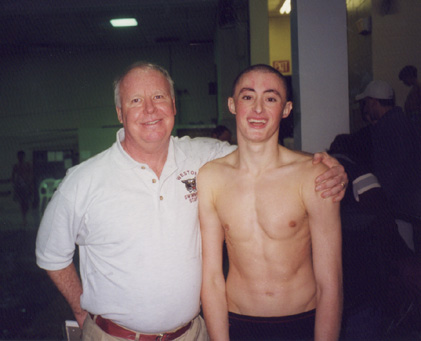
But I soon realized that I was somewhere special, and for this I have Pete Foley to thank. Foley, at that time, was already a legend in the town. He was not only the swim team coach, but also the athletic director responsible for the oversight of all teams. I recall his office as being filled with trophies, team photos, candids and loads of paperwork; the faces on the walls and desks spoke volumes. During that first year with the team I worked as hard as I had ever in my life.

It’s always difficult to say right off the bat how some people are able to inspire others. With Foley, part of his genius was that although he was always present, in fact a force, he never micromanaged. That is, he was able to channel his efforts so that group cohesion would grow upon itself. And so I went from being a relative loner to a member of this great extended family which was the team. Now don’t get me wrong, there were days when the last thing we wanted to do was even dip a toe in that pool, but somehow “The Folz” kept us going.

My first moment with the Folz was born out of less than fortuitous circumstances. I had completed the backstroke leg of a 200 yd medley relay (order = back, breast, fly, free.) We had done well, a respectable third place. However, after the final member of the medley clocked in, I though it would be in order to hop back in a swim a warm-down lap, after all, this was the standard practice after a sprint. What I failed to realize was that in the case of relays, only the last swimmer was entitled to this lap, and if a member from a previous leg touched the water again then the group was disqualified.

I recall vividly that as I was in the air between the lip of the pool and the surface of the water, I turned to see the Folz looking at me in horror. Of course what followed was an ignominious whistle by the referee (a grumpy one,) followed by the notice that I had just disqualified the relay. But it was what happened next that was really the main event. Foley came over and explained what I had done. He was upset, of course, but he was not vituperative and he did not embarrass me any further than I already was. I knew I had screwed up bad, but I never once felt defensive. Later that evening on the bus ride back to town the team captain came up to me with some encouraging words; again the entire team was “on message.”

Thankfully, not all Folz moments were born out of such circumstances. There was, for instance, the training trip in Maine. While at a restaurant, he was approached and asked for his autograph. Although Folz was well known and respected, high school swimming coaches are not usually afforded such a request. We soon realized that his would be admirer had mistaken him for John McCain, who at that point was driving his Straight Talk Express around New England… At the end of the school year I wrote into the McCain campaign and requested a poster (can you believe that?) which arrived promptly. After those of us who were present at the original signing signed it ourselves, we presented it to him. He was, of course, quite flattered…

My senior year I was elected one of the team’s captains. Of course, these four years were full of other stories, events and mishaps. Let it suffice to say, though, that the transition from a scrawny 15 year old kid to a confident and trusted team leader was due to the leadership of the Folz. But even more important than my story is the fact that there are a few hundred people out there, from 18 – 50 years old now, who have a similar one thanks to this man. Pete Foley was both a kick in the ass and the inspiration that drove us to be champions. As he enters his long deserved retirement, he can rest assured that his contribution to the team, the town, and hundreds if not thousands of young men and women will never be forgotten.

Thanks Folz,

Personality Test

Neuroticism
89
Extraversion
17
Openness To Experience
59
Agreeableness
18
Conscientiousness
41

You are introverted, reserved, and quiet with a preference for solitude and solitary activities. Your socializing tends to be restricted to a few close friends. You can be very easily upset, even by what most people consider the normal demands of living. People consider you to be extremely sensitive and emotional. A desire for tradition does not prevent you from trying new things. Your thinking is neither simple nor complex. To others you appear to be a well-educated person but not an intellectual. People see you as tough, critical, and uncompromising and you have less concern with others’ needs than with your own. You are reasonably reliable, organized, and self-controlled.

Test Yourself Compare Yourself View Full Report

Grand Canyon

The other night I was having a conversation with one of my sitemates about our post-Peace Corps plans. Although the matter was left unresolved, (at least in terms of the long-term picture,) the conversation was satisfying in that we both concluded that we were looking forward to building roots in the United States. As much as I criticize things going on currently, my love for the USA is true and deep. As such, I’ve decided to do a road trip this summer when I return, and I’m hoping that you guys, my faithful readers, can give me some suggestions of places to see. Part of the impetus for this is the fact that although I teach American History and Geography here, I have not seen much of my own country firsthand. I’m rather familiar with the Northeast, but other than that, I’m a bit wet behind the ears! As you, yes you, have probably been many places I haven’t, I’d love to hear about some of your favorite parts of the country and why. Consider this an assignment !