Author Archives: WD

Scams of Mass Destruction

Yet another Republican scam has cost the life of an innocent American. And no, it’s not Iraq this time, but, get this, downtown Boston. Yep, this time it hits close to home, and for the Del Valle family, life will never be the same. Although statistics say that one is more likely to be killed in a traffic accident than in a plane crash, falling slabs of concrete is probably not what these numbers intend to prove. But that is just was has happened. In one of the new tunnels of the Big Dig, a large concrete ceiling panel fell onto the roadway, killing a woman as she and her husband were on route to Logan airport. Now, perhaps you may be thinking, “well, that is a shame, but there are other more pressing concerns to be dealt with at this time.” And in that you may have a point. However, though only one life was lost here (thankfully,) this incident is yet another example of the failure of the neo-conservative model of government.

The company in charge of the Big Dig is Bechtel. This should be a familiar name, as Bechtel is one of if not the largest global construction firm. Some of Bechtel’s past achievements include: Hover Dam, BART, and the Channel Tunnel, just to name a few. One could say that Bechtel is a firm so large that is has its fingers in everyone’s pie. So, it should come as no surprise that when the Big Dig was a fledgling project seeking a management consultant in the mid 1980’s, Bechtel was chosen. The real problem with this choice emerged when it became clear that Bechtel would not only be heading up the design team, but would also be responsible for the construction and safety monitoring of the project. This, which Bechtel claims is common practice, basically positioned the company as final arbiter of all aspects of the project, thereby pushing aside (or buying out) local contractors and government officials. Given that this was all taking place in the Reagan era, when the nascent neo-conservative movement was beginning to take hold, such a massive privatization of public works was not met with sufficient outrage to halt this arrangement.

The Bechtel website claims that its role in the Big Dig was the following: Management consultant responsible for preliminary design, management of the final design process and construction by other consultants and contractors, procurement, oversight of safety programs, and reporting on the project’s overall cost and schedule. Simply put, everything.
Continue reading

Cham-pig-ne-ay and Caviar

I have just finished reading, Class: A guide through the American status system. Although the book is dated (1983,) it remains relevant. Author Paul Fussell looks at what separates Americans in regards to class. Not only is this book right on, but it is also hilarious, often times laugh out loud. Fussell separates classes into nine categories, which are:

Top out-of-sight
Upper
Upper middle
– – – – –
Middle
High proletarian
Mid-proletarian
Low proletarian
– – – – –
Destitute
Bottom out-of-sight

And although money is indeed raised as a factor in segregating the classes, the book goes on to show that it is really style/taste that matters. For instance, in regards to clothing, he says:

There are psychological reasons why proles feel a need to wear legible clothing, and they are more touching than ridiculous. By wearing a garment reading SPORTS ILLUSTRATED or GATORADE, the prole associates himself with an enterprise the world judges successful, and thus, for the moment, he achieves some importance.

In his section about decorating the house, Fussell remarks:

But the most notable characteristic of middle-class decor is the flight from any sort of statement that might be interpreted as “controversial” or ideologically pointed. One can’t be too careful. Pictures, for example: safe are sailing vessels, small children and animals, and pastoral scenes, unlike images that hint any ideological import, like “France,” “Civil War,” “New York City,” or “East European Immigration.” Argument or even disagreement must be avoided at all costs.

Regarding travel, we learn:

The touristic class is predominantly the middle… The middle is the class that makes cruse ships a profitable enterprise, for it fancies that the upper-middle class is to be mixed with on them, without realizing that that class is either peering at the minarets in Istanbul or hiding out in a valley in Nepal, or staying home in Old Lyme, Connecticut, playing backgammon and reading Town and Country.

And about what we read:

As readers, proles are honest, never trying to fake effects of simulate interest in higher things. It’s among the middle class that tastes in reading get really interesting, because it’s only here that pretense, fraud, and misrepresentation enter. The uppers don’t care what you think about their reading, and neither do the proles. The poor anxious middle class is the one that wants you to believe it reads “the best literature,” and condemnatory expressions like trash or rubbish are often on its lips… the middles, the great audience for how-to books, believe in authorities.

But the passage that made me laugh the most in the book came in the section talking about drifting or shifting between classes:

If social climbing, whether in actuality or in fantasy, is well understood, social sinking is not, although there’s more of it going on than most people notice. Male homosexuals and lesbians, respectively, exemplify these two opposite maneuvers. Ambitious male homosexuals, as least in fantasy, aspire to rise, and from humble origins to ascend to the ownership of antique businesses, art galleries and hair salons. The object is to end by frequenting the Great. They learn to affect elegant telephone voices and gravitate instinctively toward “style” and the grand. Lesbians, on the contrary, like to sink, dropping from middle class status to become taxi drivers, police officers, and construction workers. The ultimate male-homosexual social dream is to sit at an elegant dinner table, complete with flowers and doilies and finger bowls, surrounded by rich, successful, superbly suited and gowned, witty, and cleverly immoral people. The ultimate lesbian social dream is to pack it in at some matey lunch counter with the heftier proles, wearing work clothes and doing a lot of shouting and kidding.

At the end of the book, Fussell talks about something he dubs, “The X Way Out.” People in this class, X people, tend to transcend these distinctions in a kind of witty an irreverent way, that is to say they distance themselves from but do not ultimately reject the existence or necessity of such constructs. If you want to read about X people, and see if you are one, you’ll have to buy the book yourself. I would like to see an updated version of this book, especially now that we have an Ivy League educated president who acts as folksy cowboy (a kind of dumbing down of America to which Fussell alludes.) For all the humor in the book, though, I think this is a very important topic for the times. Considering that the world is becoming more globalized, what does that mean to the unique American class system. Do current distinctions remain relevant, and if not, what fundamental re-structuring is called for? Hard to know, but it’s important to look into this topic, class, which seems to be the great elephant in the room when it comes to American life.

Happy Trails

Here’s an odd one for the books. This weekend I visited my original host family in Risnov. This trip entailed traveling through the Brasov train station. The Brasov train station is the epitomy of Communist-style architecture. It is big, and while it ought to thus be airy, it has the feel of a bunker. It is ugly from the outside, and even more depressing on the inside. As is typical with Romania in general, what’s inside is a total mixed bag, some modern technology and some ancient and broken holdovers. So, although I don’t like it, I’ve gotten used to the place – it is a well traveled hub.

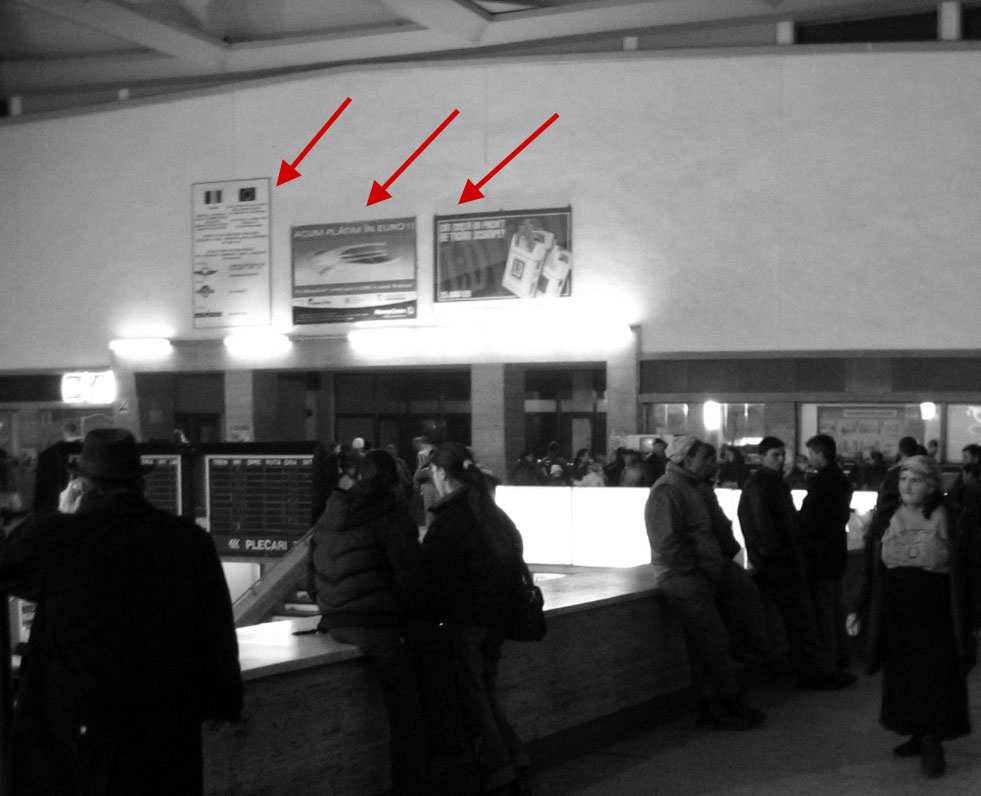
This first picture shows a particular angle of the interior of the station. Note the three advertisements on the wall.

Okay, an ugly wall and some billboards, simple.

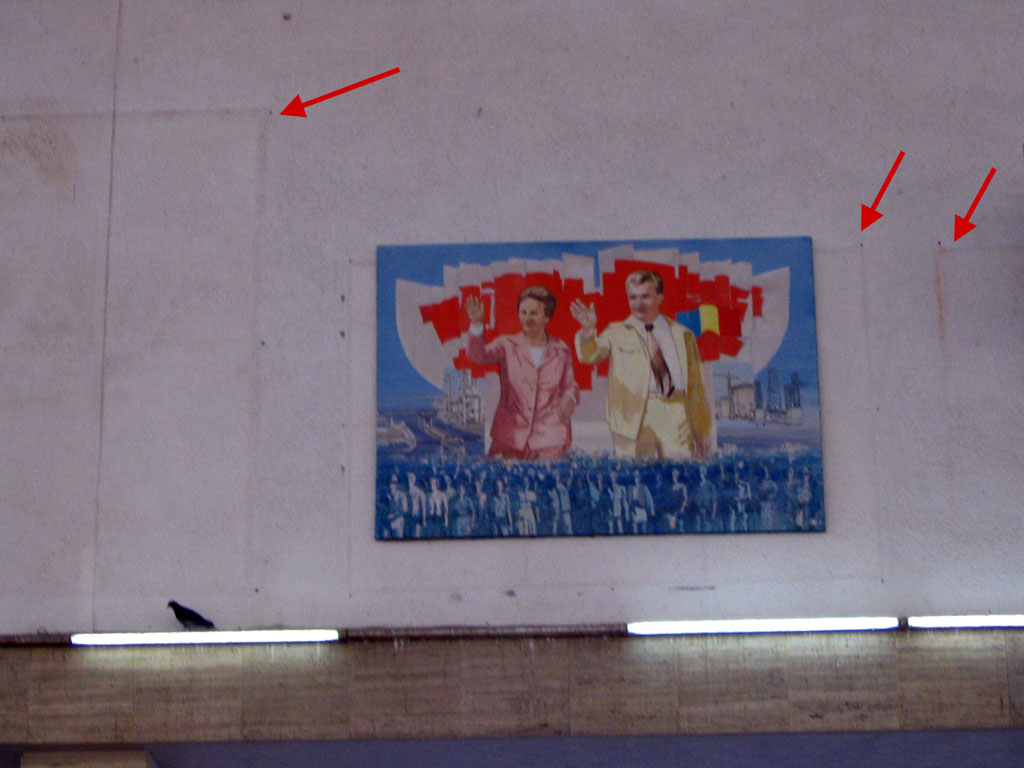
Yesterday THIS is there:

I’ve pointed out the outlines of the three billboards from the previous shot. As you can see, the outline of the middle billboard does not completely cover this portrait. Thus, it would seem that if this portrait had been there the entire time, the top would have been sticking out. Based on the original black and white, this does not seem to be the case, although I can’t be sure without more evidence.

Off frame there was some scaffolding, as it appeared that workers were in the process of replacing the ads. This only leaves me wondering where the Ceausescu portrait came from, and why in the world it was up there for all the world to see? I would think that to have the smiling countanance of the country’s infamous dictator and wife on dislplay like that would be an outrage to the average Romanian citizen, but nobody seemed to notice. As they say, “asa e Romanul.”

Drum Bun

Keeping Up Appearances

So a few days ago I am doing a load of dishes in the kitchen. When I’m finished, I go to wash my hands in the bathroom and notice that the entire floor is covered in about an inch of water. It seemed that all the (dirty greasy) water that had gone down the kitchen sink ended up here. Darn. So, this entailed a call to my landlord. Now, although landlord is usually synonymous with trouble, I am quite lucky. My landlord is an old retired man. Although the apartment technically belongs to his son, the father manages everything.

The next day he comes over with a spool of cable, gets down on his knees in the bathroom, and tries to unclog the mess himself. It doesn’t work. So, after admonishing me not to take a shower, he vows to return the next day with a plumber. The next day he does indeed show up with a plumber, and this plumber is a typical plumber: big, overalls, dirty, friendly. He takes apart the bathroom sink, does some heavy duty plunging, sticks a few cables down the drain, and about half an hour later comes up with an absolutely rank looking conglomeration of hairballs, congealed grease and toenail clippings. After this victory, he takes a look at the kitchen sink and replaces the old piping with a new flexible hose. All is well. I shake hands with the both of them and bid them adeiu.

An hour later, all is calm, and I am reading on my balcony, enjoying the fine weather. Buzz!, someone is at my door. An un-announced buzz means one of three things: Gypsy salesperson, man/woman coming to read the electric/water meters, or my landlord. I assume its him and I’m right. He has with him a little bag of cleaning products, and proceeds into the kitchen. Taking out a product called “Axion,” he dabs a bit on a sponge and begins scouring the sink. Apparently during his previous visit he concluded that I was not keeping the sink as clean as he would like. As he continues scrubbing away at the sink, I attempt to join in, but really its only a one person job. So, I just leave him be and continue to read on the balcony.

About a half hour later I come back inside and find that he has moved to the bathroom and is scrubbing the tub. He is pretty much finished, and at that point I get a short lecture about how I should keep the kitchen and bathroom cleaner. It’s not mean-spirited, but as I had been warned by my counterpart to humor him, I smile and nod and promise to keep everything more sparklinger. Before he leaves, additional notice of displeasure is given regarding my collection of shoes adjacent to the front door. A mess, he exclaims, in mock frustration, too many shoes! So I put a few of them away in a little closet and at this he is quite satisfied. I promise again to keep things cleaner in the future and he leaves satisfied.

A minute later comes the customary follow-up buzz; he always forgets something and has to come back for it. This time it is his watch. I grab it, open the door and hand it right to him. We laugh a little and he departs once again.