Author Archives: WD

Party Time

It has been an exciting week here in Romania. Firstly, school has come to a close. Yes, one year down and I have survived! I am very proud of myself, and looking back on this past year, it has been quite an experience.

The tradition here in Transylvania is for the graduating seniors and all teachers who worked with them to have a big party. We’re not talking about soda and cookies in a classroom here, rather a full-blown promesque experience. (Thankfully, this time around it was a better experience….) Since I currently work at two schools, I was invited to two different parties, on two consecutive nights. So as you can imagine, it was a fun week.

The first party was held by the Hungarian school and took place in a large restaurant. I was floored when I entered the building, because this place was opulent, wedding quality. The hall was huge (I’ve learned that it is a renovated canteen from a now defunct nearby factory complex,) and lavishly decorated. Students and teachers sat at large round tables, and we were treated to a three course meal and dancing. What I enjoyed particularly about this first party was a tradition where all the teachers stood in a giant semi-circle with a cup of champagne. The students, with their own cups, filed by, clinking and saying “cheers” with each and every one of us. Then, after all the students had gone by (30 minutes later,) the teachers at one end of the semi-circle started following the path of the students, and we began clinking with one another. I found it to be a most collegial exercise. That party went on till 5 AM, so I hear, but I was out by 2.
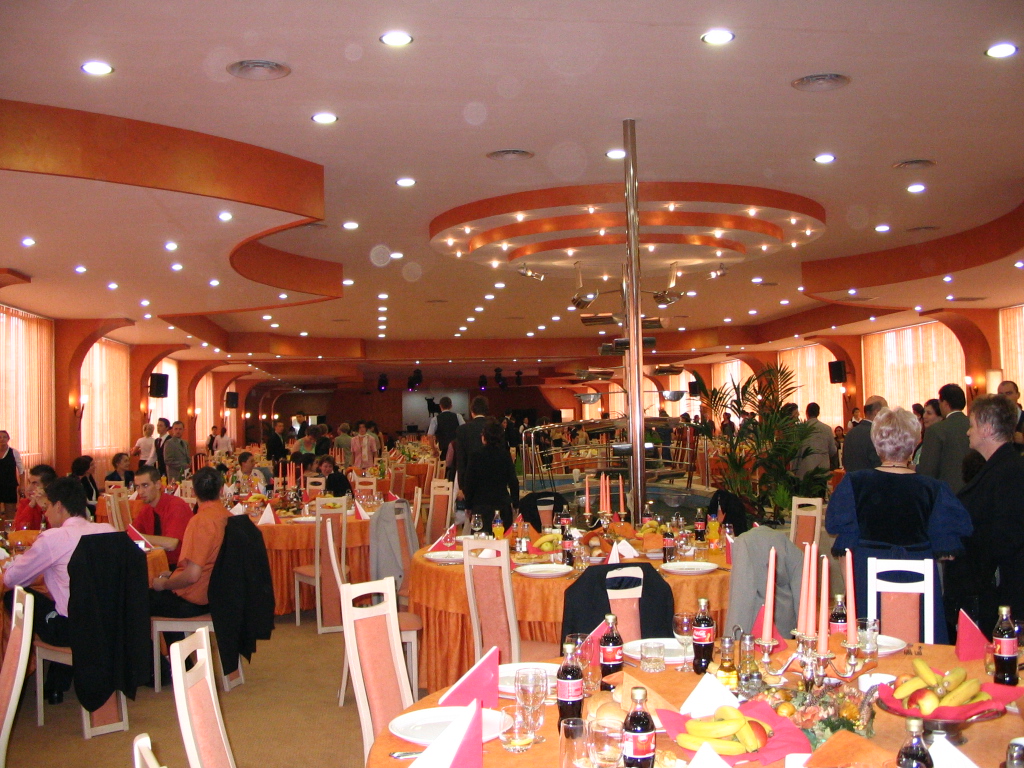
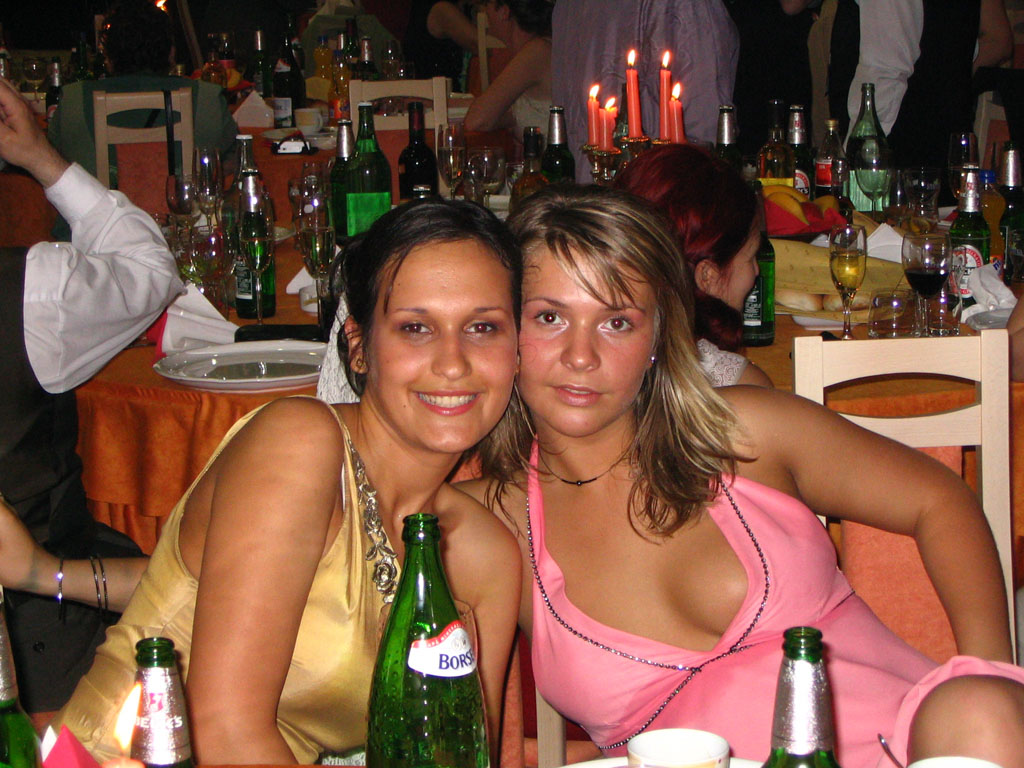
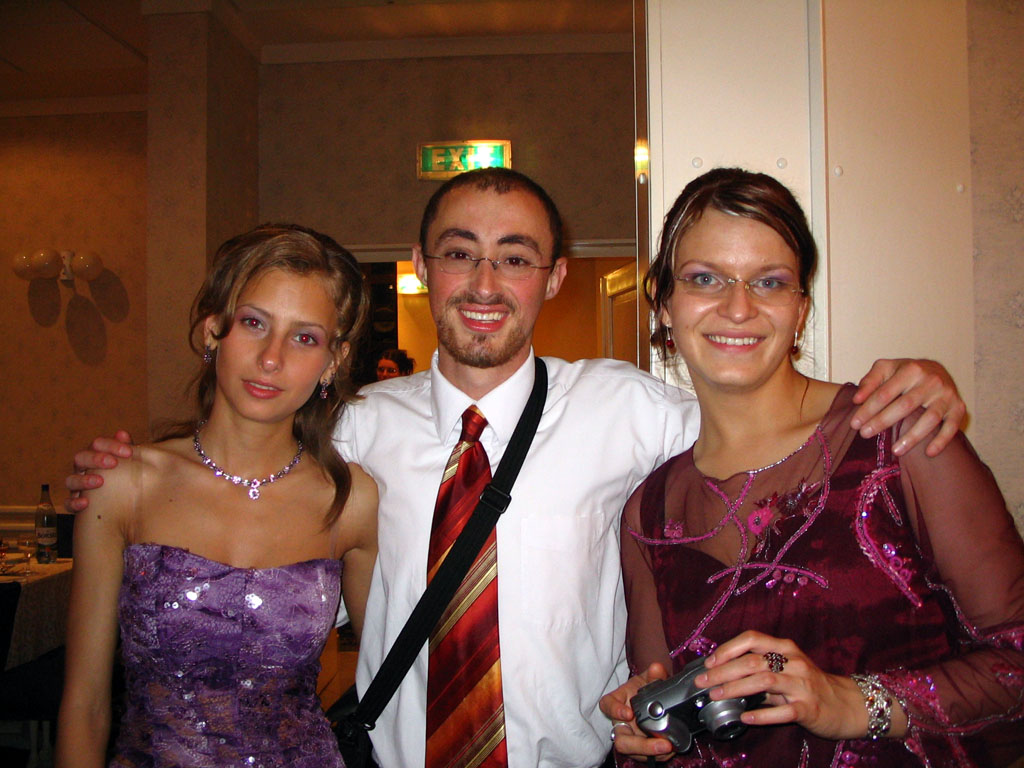
The following night was the Romanian school’s party. This one took place in the restaurant/banquet facilities of a large hotel in the city center. Although upon first glance the setting was far less opulent, this party turned out to be even better. The main difference was that the teachers had their own room. I had to laugh a little when I noticed that the tables were set up in a U pattern. This is worth noting because this style seems to be popular in many official Romanian settings (including our teacher’s room at the school.) The most important people sit at the head of the U and the rest of us further out to the edges. Therefore, being at an end of the U usually guarantees one a better time.

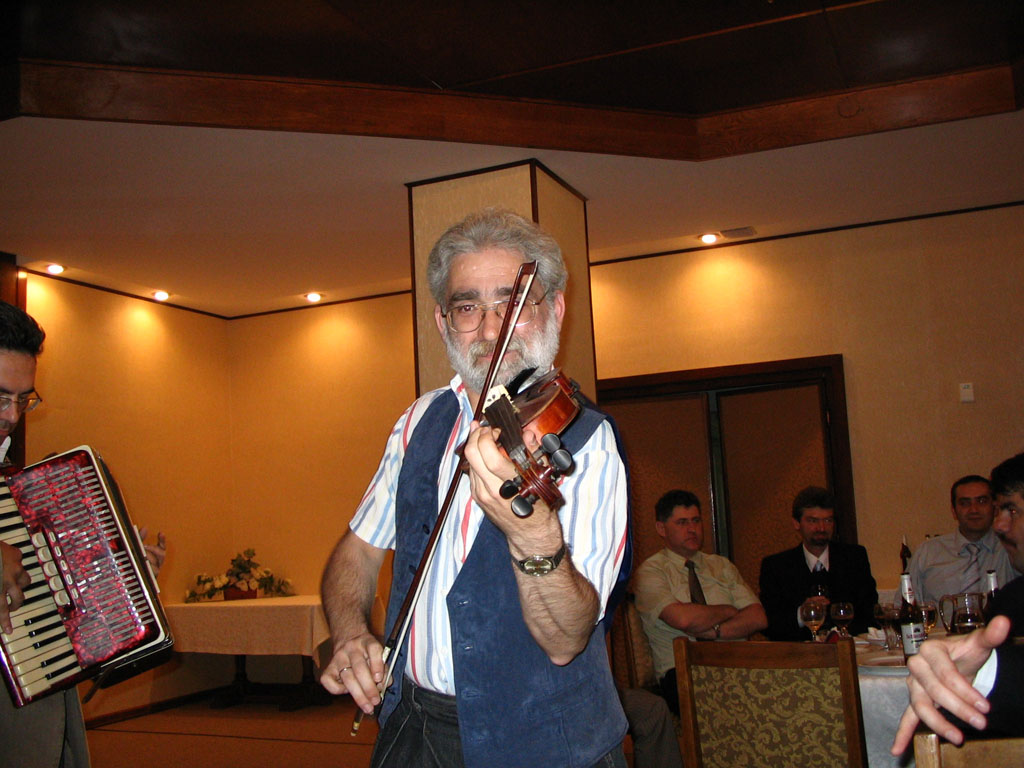
Things got off to a quick start as the waiter came through the room with a fine selection of alcohol. About an hour into the evening, after our first course, the special guests arrived. Two musicians, a violinist and an accordionist, began, to much fanfare, playing traditional Romanian festivity music. And I must say, what fun it was. Everyone was singing along, smiling, and having a good time – traits rare in the day to day running of the school. In addition to the wild entertainment, I had some great conversations with other teachers, both familiar ones and a few with whom I had been wanting speak but had yet to find a proper platform. A few other teachers also approached me, being less inhibited (and more inclined to try their English,) after a few drinks. It was a fantastic evening.
Other positives are that the weather has warmed up and the fruits are out in full force. Currently starring at the local piatas are cherries and strawberries. All are locally grown, and thus quite inexpensive. A kilogram of strawberries costs about one dollar. So, I am finding myself with more time to spend reading on my balcony with a bowl of fresh fruit by my side. Of course there is lots more on tap for the summer, but I’ll save that for the next update.


They said it really loud, they said it on the air, on the radio…

So Friday on the Mike Malloy show, Mike was discussing the story about the Marines in Iraq killing innocent civilians. Doing a great job as usual, he had been contrasting the statements made by the Iraqi prime minister with the White House spin that he had been “misquoted.” For those of you who missed this one, the Iraqi prime minister said the following:

“This is a phenomenon that has become common among many of the multinational forces. No respect for citizens, smashing civilian cars and killing on a suspicion or a hunch. It’s unacceptable.”

Although Condoleezza Rice has not subsequently repudiated those words, she followed, albeit less vocally, the trajectory taken by WH spokesman, Tony Snow as evidenced by this back and forth with Helen Thomas:

Q Where does he say he was misinterpreted?

MR. SNOW: Well, unfortunately, Helen, I have just tried to — what I’m trying is to relate to you, through Ambassador Khalilzad, through me, what was told to him through an interpreter by the Prime Minister. And it becomes a little convoluted, and so I don’t want to make a real clear characterization, because it’s a little hazy to me, too. All right? What I do know is that he was misquoted, he’s looking into it. But that what he said, and when he said it, and in reaction to what is a little gauzy.

Q You’re not telling us what he said.

MR. SNOW: But I don’t know exactly what he said. All I’m doing is giving you the characterization I repeated through the Ambassador. I’m trying my best to be your advocate on this one. But I did not have a direct conversation with the Ambassador — I mean, with the Prime Minister. But it’s interesting to note that you have — violence against civilians has become a “daily phenomenon by many troops in the American-led coalition who did not respect the Iraqi people.” This is gauzian in and of itself. It doesn’t refer to American troops. It talks about troops in an American-led coalition, which also involves Iraqi troops. I don’t know what this means. I wish I did, and I wish I could give you clearer guidance.

Anyway, Mike was taking some calls after the segment about this little incident was finished. After commiserating with an upset New Yorker, Arnold called in.

LISTEN HERE!!

Hurts soooo good,

Memorial Day ’06

Memorial Day: Today Americans pause to honor the dead of our past wars. From that fateful person in Concord to the young soldier, over 200 years later, who will die today, we salute them all. Although as a nation we have been often at war, today, May 29th, 2006, is unique. It is unique because we find ourselves in an extraordinary position. We face a challenge no less than the very salvation of our country.

Fear is a powerful weapon. Hermann Göering, Nazi war criminal, said the following:

“Naturally the common people don’t want war; neither in Russia, nor in England, nor in America, nor in Germany. That is understood. But after all, it is the leaders of the country who determine policy, and it is always a simple matter to drag the people along, whether it is a democracy, or a fascist dictatorship, or a parliament, or a communist dictatorship. Voice or no voice, the people can always be brought to the bidding of the leaders. That is easy. All you have to do is to tell them they are being attacked, and denounce the pacifists for lack of patriotism and exposing the country to danger. It works the same in any country.”

Continue reading

On the Highroad to Irrelevance: Rebuilding the Democratic Party

Today we are lucky to have a guest contribution to WorkingDefinition. In the following essay, Nate describes what makes Neocons tick and what we, as responsible and progressive Democrats, can do to counter their disproportionate influence. Enjoy!

On the Highroad to Irrelevance: Rebuilding the Democratic Party

Introduction

The term neoconservative is often used to describe the Bush administration. To many Democrats the term neoconservative is an insult, and rightfully so, an epithet, thrown as Bush himself throws the term “Massachusetts politician,” meaning a weird mixture of born-again Christianity, a smug self-satisfaction and an almost dangerous confidence that anything America touches will doubtlessly turn to gold. This is not too far off the mark but it fails in the major point that it is unable to uncover or unlock the secret of what makes neoconservatism so attractive to so many Americans.

We would best begin by defining our terms. While neoconservatism is the guiding philosophy of the Republican party, neoconservatism is not Republicanism; in fact I do not believe that it would be stretching the truth to say that neoconservatism is now operating in the burned-out shell of the Republican party the way certain parasites burrow into the brains of caterpillars and then take over their bodies – the caterpillar is no longer in control, but it still looks like a caterpillar. Therefore, as we read research and write, we would do well to understand that while they are currently synonymous, Republican and neoconservative do not mean the same thing.

One of the apostles of the neoconservative doctrine is commentator Irving Kristol. Kristol’s collection of essays: Neoconservatism: an Autobiography of an Idea provides an excellent explanation of this dichotomy. Kristol, whose two primary fears in life seem to be lesbians and African-Americans in that order, suggests that from the administration of Franklin Roosevelt until the early 1990’s, the Republican Party in the United States was largely dead. Dependent on raising the banner of anti-communism and fiscal responsibility Kristol states that the Republicans merely looked like miserly fear-mongers in the face of the high ideals of Democrats and as such made no progress, representing a minority in the House and Senate.

For Kristol, neoconservatism was the parasite that burrowed into the nearly defunct Republican party and gave it new life, the life that has given the party the wherewithal to capture all three branches of the United States government in a mere twenty years. At some level this understanding of neoconservatism existing inside the shell of the Republican Party can be comforting to Democrats. People who vote Republican believing they are voting for fiscal responsibility and small government may eventually realize that they are actually voting neoconservative thus causing a major rupture in the Republican ranks, but this supposed rupture might easily come too late to prevent an irreversible sea-change in American life and government.

The foregoing being said, it begs the question: if Republican doesn’t mean Republican anymore, and instead means neoconservative, why do people still vote for Republican candidates? Shallow pundits such as Anne Coulter would suggest glibly that anyone who doesn’t vote Republican (meaning neocon in this case) is a) unpatriotic, b) brain-dead, c) gay, d) an environmental nut, or e) all of the above. Alas for Coulter and her ilk their simplification of neoconservatism for a radio audience merely serves to highlight their own stupidity. The fact is that neoconservatism is a highly complex doctrinal system based on intense and perhaps fevered readings of history and classical philosophy with an emphasis on Socrates and Aristotle.

In my own work as a consultant for the non-profit sector I am often asked by struggling organizations “we do such good work, why don’t people want to fund us?” Often times we return to them with the same solution: “do only those things which directly advance your mission; package and clarify your work for funders.” If we can for a moment imagine neoconservatism as an automobile, the success of the doctrine becomes clear in short order; yes it has a complex supply line, yes building it is a lengthy and involved process, but with a coat of well-lacquered paint anyone can tell you it’s a car. Taking the automotive analogy one step further, the hiding of neoconservatism within the Republican Party also helps to explain the doctrine’s success. Neoconservatism has enough parts drawn from classical Republicanism to appear very similar, almost indistinguishable to last year’s model such that a casual observer won’t be able to tell the two apart until he’s been driving long enough to read the fine print under the clock on the dashboard.

Continue reading